Pinched Flow Fractionation (PFF)
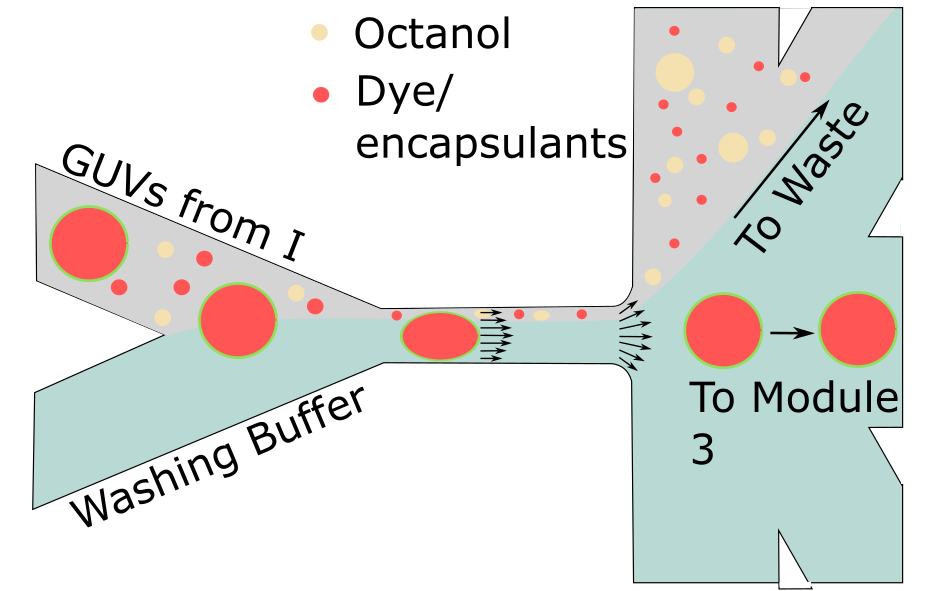
Mechanism
Pinched Flow Fractionation (PFF) is a technique for purifying particles in solution. It has typically been applied to purify particles of a particular size under flow.
PFF devices work by constraining fluid flow through a pinched segment that is a similar width to the diameter of the particles to be separated. After the pinched segment there needs to be a widening of the flow to achieve separation. The separation principle is a direct consequence of two useful aspects of microfluidic flows. First is that microfluidic flows are laminar, meaning streamlines do not cross. Secondly, over short timescales, such as the passage times of small particles through the pinched segment, particles tend to flow along the streamline of their centre of mass. Unless an external force is applied to knock them off their streamline, the particles will flow pretty much on a single streamline for the duration of their passage through the device.
Applications
This design is ideal for applications such as removing unencapsulated waste residue from the external solution, rapidly removing reactants from the environment of the vesicles, or rapidly introducing new components to the vesicles.
Design files
References
- Tivony R., Fletcher M., Al Nahas K., Keyser U. F., A Microfluidic Platform for Sequential Assembly and Separation of Synthetic Cell Models, ACS Synthetic Biology, 2021, 10, 11, 3105-3116.