Octanol-assisted Liposome Assembly (OLA)
Mechanism
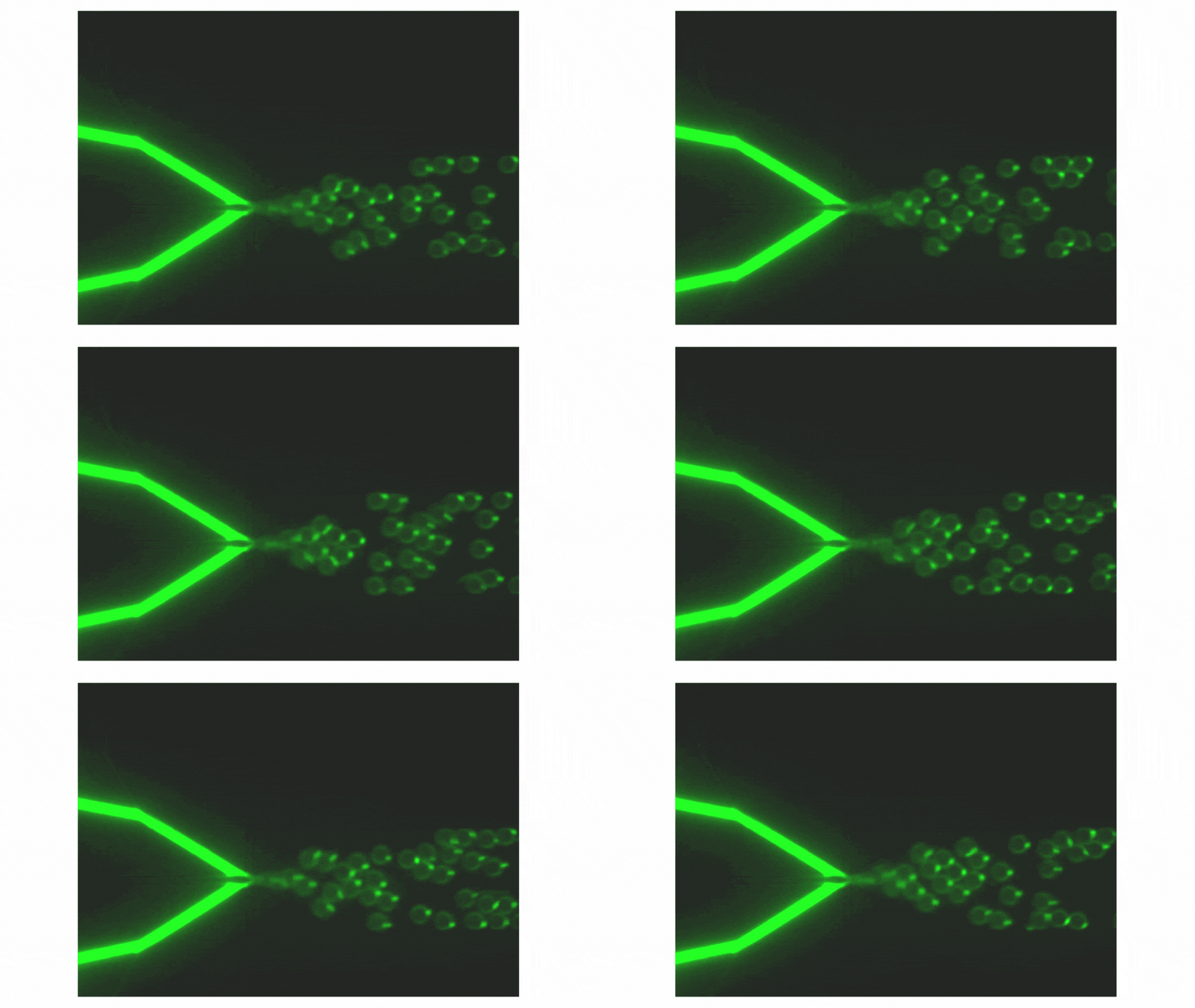
Octanol-assisted Liposome Assembly is a technique for generating highly uniform lipid-vesicles with diameters similar to mammalian cells (typically 10-50 microns). A lipid vesicle is essentially a spherical bubble, where the membrane of the bubble is made of phospholipids, the same basic molecular constituent of all living cell membranes. Lipid vesicles are an attractive chassis for making synthetic cell mimics as they are the native environment for membrane proteins which provide most of the functionality of the real life cell membrane. Whilst several techniques exist for making lipid vesicles at the size scale of cells, microfluidics stands out as the technique which produces the most uniform lipid vesicles in terms of size and encapsulation efficiency. Given the highly repetitive flows of droplet formation, it is the most likely technique to produce almost identical vesicles.
The OLA microfluidic device in this tool-kit works by combining three fluidic phases, the Inner Aqueous, Lipid-Octanol and Outer Aqueous in one step at a 6-way fluidic junction to produce Water-in-Oil-in-Water double emulsion droplets. Both the Lipid-Octanol and Outer Aqueous flows bifurcate about the inner aqueous to create the 5 inlet streams into the 6-way junction. By tuning the flow rates of each flow, we can end up in a regime where the Inner aqueous is encapsulated first in the Lipid-Octanol phase and then almost immediately these Water-in-oil droplets are encapsulated in the Outer Aqueous solution, creating the double emulsion droplets. This process requires careful tuning of surface properties to enable double emulsion droplet formation, where the initial part of the device has hydrophobic surface to promote the Inner Aqueous encapsulation in the Lipid Octanol phase. The surface properties are switched to hydrophilic at the latter half of the formation junction to encourage the oil phase to be encapsulated in the outer aqueous. The second trick of the OLA method is the choice of octanol as the oil which dissolves the lipids. The inventors of the technique found that octanol would spontaneously phase separate from the lipid, leaving a lipid bilayer and a separate octanol droplet.
Applications
This design is ideal for producing synthetic cell models with very high encapsulation efficiency and at high throughput.
Design files
References
- Deshpande S. et al., Octanol-assisted liposome assembly on chip, Nature Communications, 2016, 7, 10447.
- Al Nahas K. et al., A microfluidic platform for the characterisation of membrane active antimicrobials, Lab on a Chip, 2019, 19, 837-844.
- Fletcher M. et al., DNA-based Optical Quantification of Ion Transport across Giant Vesicles, ACS Nano, 2022, 16, 10, 17128-17138.
- Tivony R. et al., Quantifying proton-induced membrane polarization in single biomimetic giant vesicles, 2022, 121, 12, 2223-2232.