Lipid Mixing
Summary
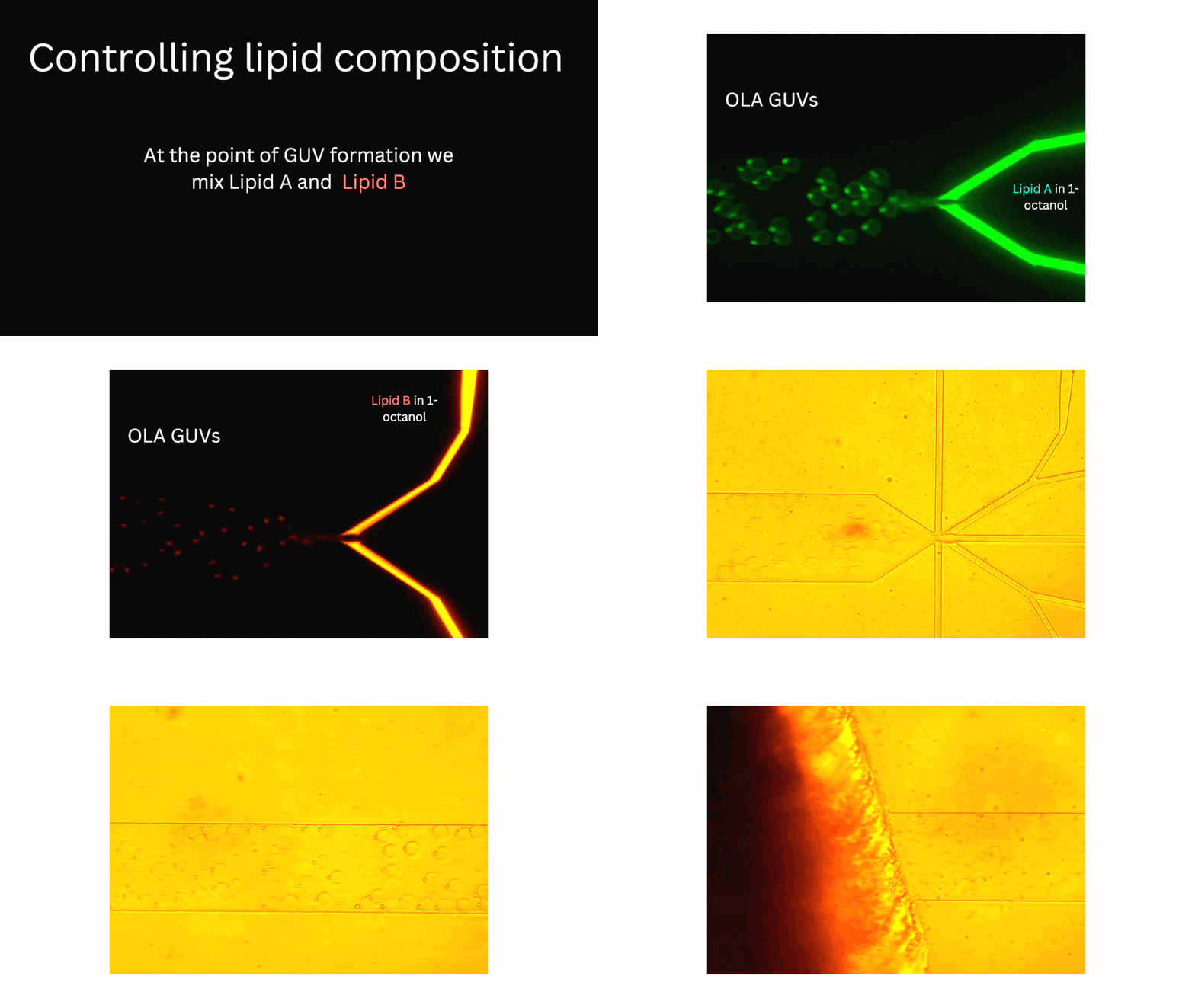
This module varies the membrane composition of giant unilamellar vesicles (GUVs) while they are being produced. Two independently controlled lipid-in-octanol stock phases are combined on-chip immediately before an octanol-assisted liposome assembly (OLA) junction. Changing the relative delivery of the two stocks changes the lipid mixture supplied to vesicle formation, without preparing a new bulk lipid stock for every composition.1
The approach is intended for rapid exploration of membrane composition-function relationships. In principle, computer-controlled pressure or flow regulation can move through a sequence of compositions during continuous operation, enabling composition libraries for synthetic-cell development and membrane biophysics.1
How it works
The complete device has four fluidic inputs:
- inner aqueous phase;
- lipid stock A dissolved in 1-octanol;
- lipid stock B dissolved in 1-octanol; and
- outer aqueous phase.
The two lipid-octanol streams meet at a Y-junction directly upstream of the OLA formation junction. Under laminar co-flow, their relative volumetric flow rates determine the fraction of each stock delivered to vesicle production. If the two lipid streams have flow rates QA and QB, their approximate contributions to the mixed lipid phase are:
- Fraction from stock A:
xA = QA / (QA + QB) - Fraction from stock B:
xB = QB / (QA + QB)
The mixed lipid-octanol phase then participates in the standard OLA process: an inner-aqueous/lipid-octanol/outer-aqueous double emulsion forms, after which the octanol-rich phase dewets to leave a lipid bilayer around the aqueous compartment.12
Controlling composition
Adjust the ratio QA:QB while keeping the total lipid-octanol delivery, QA + QB, approximately constant. This changes composition while minimizing disruption to the downstream vesicle-formation regime.
The published demonstration used independently pressure-controlled reservoirs. A trace amount of fluorescent lipid in one stock allowed the interface between the co-flowing lipid phases to be observed, so their relative channel cross-sections could be used to estimate the mixing ratio. The same principle can be implemented with calibrated syringe pumps or other sufficiently stable flow controllers.1
Absolute pressures or flow rates are not universal settings for this module. They depend on channel dimensions, hydraulic resistance, tubing, fluid properties and the operating window of the connected OLA junction. Calibrate the two lipid lines on the assembled device and identify a stable vesicle-production regime before running a composition series.
Experimental validation
Two complementary tests were used to establish that the input ratio controls the membrane produced:
- Lipid stocks containing different fluorescent phospholipids produced vesicles whose membrane fluorescence ratio changed linearly with the relative lipid-phase flow ratio.
- Mixtures of zwitterionic DOPC and anionic DOPG prepared on-chip produced the same trend in membrane surface charge as compositions prepared conventionally off-chip. Surface charge was measured on individual GUVs using a cholesterol-anchored fluorescent DNA probe.1
These results show that the device can vary both labelled lipids and lipids with different headgroup charge. They support using relative inlet flow as an experimental control variable for membrane composition, although a new lipid system should still be independently calibrated.
Suggested operating workflow
- Prepare compatible lipid-octanol stocks at known molar compositions and equal total lipid concentration. The published validation used 15 mg/mL total lipid in 1-octanol.1
- Establish stable OLA production with the inner aqueous, outer aqueous and combined lipid-phase flows.
- Set
QA:QBto the first target ratio while maintaining a similar total lipid-phase flow. - Allow the new composition to displace the previous mixture throughout the downstream channel and outlet.
- Collect vesicles only after production has restabilized. In the published experiments, each condition was held for 10 minutes before collection.1
- Between samples, clear residual vesicles from the outlet and repeat for the next ratio.
- Validate membrane composition with an appropriate orthogonal measurement, such as calibrated membrane fluorescence, surface-charge sensing, lipid analysis or a composition-dependent functional assay.
Applications
- Producing GUV libraries with systematically varied membrane compositions.
- Mapping lipid composition against membrane charge, permeability, mechanics or protein activity.
- Screening formulations for membrane-protein reconstitution.
- Connecting automated vesicle production to imaging and analysis modules.
- Developing closed-loop or machine-learning-guided experiments in synthetic-cell engineering.
Design files
Design files are not yet published.
References
Fletcher, M.; Elani, Y. “On-the-Fly Microfluidic Control of Giant Vesicle Compositions Validated by DNA Surface Charge Sensors.” ACS Nano 2025, 19, 13768-13778. https://doi.org/10.1021/acsnano.4c16289. ↩︎ ↩︎ ↩︎ ↩︎ ↩︎ ↩︎ ↩︎
Deshpande, S.; Caspi, Y.; Meijering, A. E. C.; Dekker, C. “Octanol-assisted liposome assembly on chip.” Nature Communications 2016, 7, 10447. https://doi.org/10.1038/ncomms10447. ↩︎