About our work
Biomolecular Systems Engineering
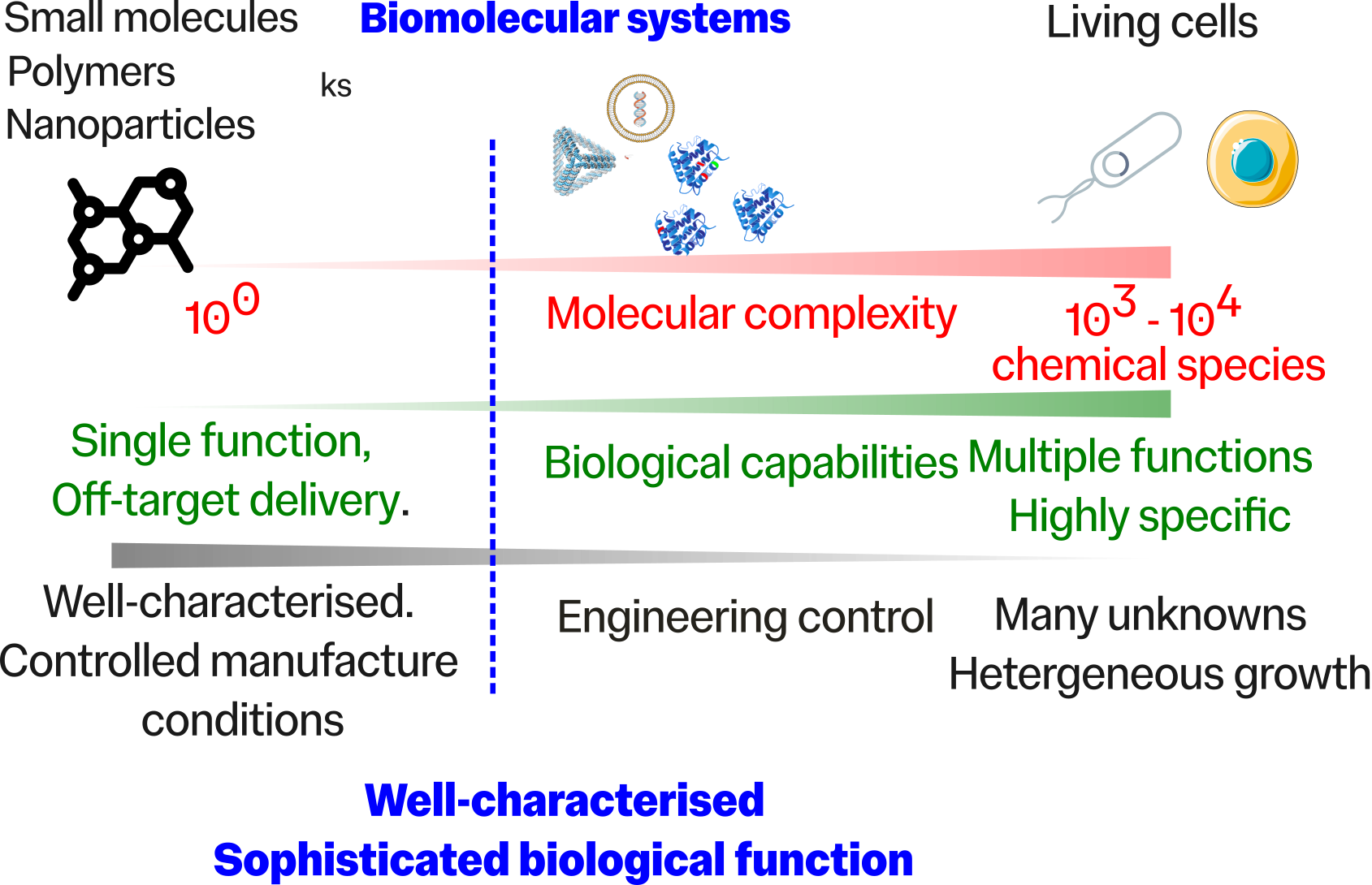
We want to understand how to build molecular systems with functions currently unique to life, such as pumping against a gradient (active transport), holding a subsystem away from equilibrium (energy storage), and switching between states in response to a chemical signal (a molecular switch, or memory). Living systems achieve these not through any single clever molecule but through the dynamics of reaction networks held far from equilibrium, where the directional, useful behaviour is set by the network’s kinetics rather than by thermodynamics alone. Decades of theory have mapped which network structures should give rise to switches, oscillators, and homeostasis—yet turning those networks into real molecules that behave as predicted has proven remarkably hard. And whilst the past twenty years have produced striking synthetic systems that convert chemical energy into work and sustained non-equilibrium states, much of how biology transduces energy through networks remains neither understood nor replicated in molecular systems. Despite this lack of progress, network theories many interesting behaviours are within reach, requiring far fewer components than living cells (see Figure)
Our central questions are: First, how can we realise in the lab cell-like systems with primitive life-like properties, such as the ability to store energy, do work, oscillate or sustain itself away from equilibrium? And second: what chemical strategies does biology use to tune its reaction rates into the regimes each behaviour demands—and can we borrow those strategies to build far simpler networks from enzymatic and organic chemistry? We aim to tackle these questions both experimentally and theoretically, building energy-transducing networks in membranes and characterising them with automated microfluidics.
The core technologies we will develop to engineer these systems are general-purpose tools for molecular systems engineering in synthetic biology and can be reapplied in synthetic cell development, lipid nanoparticle development and membrane protein reconstitution.